Showing posts with label ecology. Show all posts

Sunday, 7 October 2012

Yellow Staghorn

We saw so many species at Delamere that I couldn't possibly actually do an entry on each one -- partially because I'm not sure that any one person got a full species list.  I can, however, do entries on the ones I got good pictures of.  One of those species is Calocera viscosa, which has a few common names including yellow staghorn, staghorn jelly, jelly antler, yellow false coral and yellow tuning fork.  We were lucky enough to find a fantastic looking one:


Yeah.  I know!  This is one of the reasons I was so happy about yesterday's mushroom day.  I was going to write about how I was surprised that there wasn't a common name for it along the lines of "false fire" until I looked up the literal translation of the scientific name for it.  Calo refers to calor, which refers to heat, inflammation, glowing, fires of passion.  Cera literally just means wax and viscosa, well, viscosa refers to the fruiting body being viscid or greasy.  "Greasy fire wax" is how I prefer to think of it, especially as a bit more research also tells me that a taxonomist called Wallroth in 1833 decided to call it Calocera flammea, but the name didn't stick.  I agree with him though.

This beautiful fungus can get up to 10cm in height and is often found on dead conifer wood.  I believe this one was on a felled pine, though it was a bit past it in terms of identification.  If this fungus looks like it's growing from the floor, it's probably actually growing on dead coniferous roots under the soil.  It's a saprophyte, preferring really and truly dead trees and is present between June and December.  It's pretty common and widespread in Britain and Europe; I also found out that it's present in Canada and North America (at least in parts). It also has a white form, but that's a pretty rare find.

It's not poisonous, but being a jelly fungus means it's got an odd texture and from all accounts it's got a nondescript taste and odour.  It's another one of those that sounds like it falls into the "technically edible" category.  I recently read a book that used the term "edible, but not worthwhile", which sounds perfect for this species.  Personally, I'd rather just look at it in vague wonder and take some great pictures.


I still say that it looks like suspended pixie fires.  Yes, it's really that bright a colour.

Edit:  Ironically, during the writing of this post, a candle just burned a hole in the carpet.  /facepalm.

Saturday, 6 October 2012

Mushroom day

Despite the starter motor in the car being knackered, I still went to Delamere for the fungi day today. There's a train station in walking distance, so I took that option. It was fantastic and totally worth it. I learned so much today, saw some fascinating things, got lots of pictures, and met some lovely people. It's safe to say that I'll be writing about some of the species I saw on this visit for the next several entries on this blog. Looking forward to getting it all onto a computer as posting from a phone totally shortens what you want to say. If you do ever visit Delamere, I recommend the cafe at the station that I'm currently sat in. It does ace tea and scones.

Thursday, 4 October 2012

It's a TRAP!

This afternoon I popped over to The Barn Countryside Centre in Manchester for a couple of hours.  This afternoon's activity with the Greater Manchester Ecology Unit was laying out traps for checking tomorrow.

Firstly we were introduced to two different traps -- Longmans (top), which I've already talked about before (and got a picture of this time!) and tube traps (bottom):


The Longmans and the tube traps both work on the same principle:  Open door with food.  Small mammal enters, hits a trip, which closes the door.  In the tube trap, this trip is the white bar at the top (the paddle at the bottom is the door).  Longman traps cost around £60, but tube traps cost around £20.  However, tube traps don't do so well in the wet as the door doesn't necessarily function properly because the plastic sticks, so it's all about when and where you're using them.

We took out 30 Longman traps and baited them with seed and dog food.  The dog food is added for your insectivorous types, i.e. shrews.  I have to admit to putting quite a large teaspoon in due to residual guilt of previous trappings.  We also added a tennis ball sized amount of bedding in the form of hay and dried grass.

We laid out three transects of 10, spaced at 5m intervals.  On our way out to lay the Longmans, we passed by some hedgehog tunnels that had been laid out.  Two of them had been pulled into the path and the sausages had been nicked, presumably by dogs.  Shame.

Tomorrow morning, we'll get to see what turns up!

Wednesday, 3 October 2012

Green Alkanet + Update

This week is turning out to be quite busy.  Not only did I do my day at Record this week, and I'm in work (and working outside of work too), but I've also got two mammal trapping days and a fungi day on Saturday.  Big week, so expect some updates later in the week and across the weekend.

Outside of that, on my days at work I often get to walk through a park.  I've seen a few interesting plants and things on my way in (I often plunder the hedge, if I'm honest) and snapped a few pictures.  Recently, I've noticed a wildflower called Green Alkanet (Pentaglottis sempervirens) on my way to and from the car.  It's a charismatic very green plant with very blue flowers that have a white centre.  The plant is also pretty hairy -- to the point where it can feel a bit like stinging nettles in some of the older specimens.  It's part of the borage family, which is fairly obvious once you know that plants in this family tend to have blue flowers and be hairy:


Look at that stem! 

Anyway...

It's scientific name has stuck in my head ever since I heard it; literally translated, it means "five-tongues always alive" (or five-tongues evergreen).  Green Alkanet has also confused me as a name, so I've decided to look into both of the names as well as the plant.

Apparently the "five-tongues" part refers to the five tongue-like petals.  The corolla does kinda look like five tongues, complete with that central groove you've got underneath... as long as you squint.  It's more about the shape than the colour in this case.  It's called "always alive" because it's an evergreen plant that keeps it's leaves over winter.  The scientific name is something of a descriptor, really.

As it turns out, the name "Green Alkanet" is also a descriptor.  In this case, the word "green" is referring to those evergreen tendencies.  Alkanet's an odd one though because it's a hand-me-down word.  Alkanet is a Middle English word which was a conversion of an Old Spanish word, alcaneta, which is a form of the Old Spanish word alcanaAlcana comes from the Medieval Latin alchanna, which has been nicked from the original Arabic language, where it started of as al-ḥinnā’Al-ḥinnā’ literally means "the henna".  It's literally called evergreen henna because red dye can be extracted from it's roots.

That's why it was brought here.  It's an invasive plant from the continent, native to southwest France and, fairly obviously, the Iberian peninsula where Spain is a main feature.  Britain used to have a lot of monks that really liked having that red ecclesiastical cloth, so they imported the plant in order to create dye.  It's hard to say when this happened, but it's fair to say it was quite some time ago.  Green alkanet is considered naturalised as it's very common in hedgerows, though as you move north, there is much less of it.  I was surprised to find it near us because the land here is quite acidic and it's a calciphile.  Here's a better picture of the tongue shape from Wikipedia commons:


I still can't help but feel that after likely being here for over 1,000 years, it's part of the historic landscape, despite my usual loathing for many invasive species.  Having said that, it's not as destructive as other invasives like knotweed or rhodi, so that's definitely colouring my view.  But I shan't go into that here as that is a massive subject for discussion!

Friday, 28 September 2012

Small Mammal Trapping

Today I went small mammal trapping in Stockport with the Greater Manchester Ecology Unit.  It was a morning collection, so we were picking up the contents of traps laid out last night.  Sadly I wasn't able to help out yesterday due to teaching on my only Thursday all year.  This was double sadly as I'd also been offered both an evening and a morning bat survey by a firm, but so it goes.  Keep on swimming...

The traps that we were using were humane traps -- Longworths to be precise.  It's been some time since I used them, but they're awesome little things.  They don't hurt the little critters at all as long as you stock up the trap with a good deal of food and warmth, which is precisely the kind of thing that these creatures are after in the first place.  The traps look like this:

(Image from University of Aberdeen as I forgot to snap one...)

They come complete with a little door and everything.  The mammal survey at Etherow was two transects of 20 traps set at 10m intervals.  The first transect was near a field margin and had largely been disturbed by either dogs or badgers -- both were really likely in that part of the woods.  We did manage to get our hands on one that wasn't disturbed and that had caught a woodmouse (Apodemus sylvaticus).  In order to get a good looksee, you have to dump the trap into a plastic bag, which gives you a confused looking mouse, looking up at you:


On this survey, we were recording the state of the trap (disturbed, open, closed); what, if anything, we caught; mortality and any other notes (juvenile/adult, gender).  We also took hair samples from the mice for DNA analysis for a study of genetic drift in populations of mice.

The second transect, which was up in more dense woodland and off a path, yielded more variety as we also found bank voles.  These chaps are a far more reddy brown than woodmice.  They've also got smaller ears by comparison and have (I think) a blunter, less refined muzzle.  We caught a juvie (so small!):  


And we shall call him Bitey, because that's exactly what he did to the lass who was holding him.

We also caught and sexed a couple of others, which were mostly male.  Apparently, if you hold them a certain way, the vole stops struggling and you can tell it's gender: 

 
And this one I shall call Peevish, because he looks not only indignant, but peeved.

We didn't catch any shrews, which is a first for me, but also makes me quite happy.  Shrews have such a fast metabolism that unless you cram the trap with food and rescue it sharpish, they starve to death.  In fact, they can die of starvation in only 5 hours as they need to eat up to 300% of their own body weight every day.  To do this, they must eat every 2-3 hours.  That's one hell of a downside, but they do eat everything and anything -- including canned hotdog sausages.

Canned hotdog sausages are great bait for hedgehog traps.  These traps don't trap the animal, but they do attract them and cause them to walk through either ink or some kind of paw print capturing surface for ID purposes.  The trap below used a mixture of ink and washing up liquid, with paper to capture prints and a hotdog as bait:


These traps were laid out as one transect of 10 traps, along the edge of a path, with one trap every 100m.  We think that the first trap may have had a shrew in it, but that's only a maybe based on paw prints and teeth marks.  We also found evidence of bank voles and woodmice in the other traps -- did I mention that I can now ID rodent poo?  Well, I can now for these two species. We also found slugs in some of the traps as well as evidence that one of the little critters had pulled the hotdog out of the trap and off somewhere.  Inky dragmarks are a dead giveaway!

Sadly, we saw no evidence of hedgehogs.  I do not know if this is normal for this site, but I do know that hedgehogs are in decline but no one really knows how much by.  Here's hoping that either they went to ground last night or that they just never really liked that site.

All in all, it was a really interesting and productive day.  Incidentally, Etherow had a diverse amount of fungi about, so it's well worth a further investigation.

Friday, 21 September 2012

Moths at Delamere (or Why I find Moths Uninteresting)

I'm interested in most things, but moths are apparently where I draw the line.  I don't like them.  Don't get me wrong though; I don't hate them either.  I'm indifferent to them, which is somehow worse.  It's not because moths are invertebrates or that they're not charismatic (because some are).  I just don't find them interesting.  Part of the problem is that there is a large group of moths that even the experts call SBMs (Small Brown Moths) that cannot be identified without microscopic examination of their genitalia.  One of the things that was discussed on the moth night at Delamere was the difference between micro moths (mainly SBMs) and macro moths, and of course the difference between moths and butterflies.  So, here is a brutally quick summary of what I learned:

  • Butterflies have slender, filamentous feelers with clubs on the end.  Moths, on the other hand, have either feathery or comb-like feelers.  If the feelers are clubbed, they won't be filamentous.  Usually, anyway.
  • There are a few technical morphological wing differences.  I tend to think of them being that butterflies look more hinged, whereas many moths look more like the wings are "back-triangles".  
  • Butterflies are slender and sleek bodied.  Moths are sturdy and often a bit hairy or furry of body.
  • Butterflies tend to be more colourful -- but not always.  Some day flying moths are really very colourful indeed, especially if they're toxic.  This chap below is a five-spot burnet moth (Zygaena lonicerae) that I saw on Lundy:


Pretty colourful for a moth, eh?  Apparently the French name for moth translates to "Butterflies of the Night".

Some moth traps were set out during the day and were of two types -- wine traps and actual traps.  Wine traps are pieces of string soaked in "nectar" comprised of molasses, brown sugar, honey and red wine.  These are then left in hedges or trees to attract the moths, to do their work, like so:


Apparently, this is a copper underwing moth on a wine trap.  I was lucky to get the picture as a lot of folks were shining torches at it, which sadly made many a moth leave the traps.

The other trap involves setting up a light rig and a moth maze made out of egg cartons.  The light pulls the moths in, which you can then scoop out to examine.  These traps are also excellent for catching craneflies!  However, these traps are not so practical to cart about as they require either a plug socket or a genny.  The chap giving us the demonstration mentioned how he'd actually had one of his generators stolen from a site too.

I hate to say it, but after seeing some of these chaps up close, some of the bigger, easier to identify moths are winning me over a bit, if only because the camouflage is top rate -- and no wonder, given they fill the ecological niche of pollinator and bat food.  However, I seriously doubt I'll ever get the urge to study SBMs.

Thursday, 20 September 2012

MapInfo at Record

Yesterday was spent working with MapInfo at Record.  I am now pretty much dedicated to using my GIS skills whenever I pop in, which is fine by me as I don't mind a bit of GIS (for my friends, it means geographical information systems).  The last time I was up there, I spent the day digitising site boundaries.  Yesterday I spent the day creating citations -- documents about wildlife sites, essentially.  Not enthralling work, but necessary and good experience.

I'd totally forgotten what a pain GIS can be, however.  Most of the day was pretty productive as I was taking the site data and layering the MasterMap tiles under it and outputting the images.  But I hit a pretty big stumbling block by the end -- the upper Mersey Estuary.  The map tiles contain a *huge* amount of information.  I needed to load up 6 or 7 tiles to get the image I needed because water features cross tile boundaries.  MapInfo kept saying no.  Well, actually, it never said no.  It said "in a minute" and "when I can be bothered"  and "when I feel like it"  and "yes, but I'm going to uncheck this box just to make it more entertaining for us both."  GIS is a cruel master sometimes.

It took me four and half hours create the citation images and sort various queries for around 50 sites.  It took me half an hour to sort just the image for the estuary due to its size.  There's always one, isn't there?

After that, I had a wander around the zoo again, stopping at the Roman garden for a bit before failing to see the otters but finally seeing the warthogs.  They've stopped hiding from me, which is nice!

Tuesday, 18 September 2012

Bats at Delamere

This last weekend was pretty busy as I went along to Chesire Wildlife Trust's Bat & Moth evening as well as taking a day out at Yorkshire Sculpture Park.  On the upside, that makes for quite a few articles.  On the downside, that makes for no time in which to write them, especially when you consider that I work part-time as a lecturer and it's enrollment week!

Friday's Bat & Moth evening was pretty nifty, split into a bat watch and walk, as well as an introduction to moths and moth trapping, so I'm going to do a few entries on it in a similar way.

The bat watch & walk was really interesting and informative, though a bit more technical information about the frequency ranges of the bats we were picking up on the bat detectors would have been more helpful -- but you can't have everything.  We did an emergence watch and saw quite a few brown long-eared bats (Plecotus auritus) leaving their roosts in one of the older buildings at Delamere.  They were really loud at the 43 kHz range on the bat detectors, which is no surprise as their call range is 27-56 kHz.  However, it's really worth noting that you'll see these critters before you hear them usually as the detectors only work on their quiet calls up to a distance of 6m, hence their other name, whispering bats.  A good daylight indicator of these chaps being around is moth wings under the roost (most favoured moth being the Yellow Underwing) and of course, bat droppings on the wall.

As soon as they left the roost, they immediately headed for the closest tree to feed.  They are gleaning feeders, meaning that they eat the insects that alight on leaves and tree bark.  Unfortunately, as it was a bit dark and the bats were a bit far away (who'd've thought, eh?) I wasn't able to get any pictures of any bats that evening, however, here's a picture from wikimedia commons of what a brown long-eared bat looks like:


They look far more charismatic as a species when they're moving and not stunned.  Bad photos even happen to bats, apparently!

The next bats we fleetingly saw and certainly heard were the pipistrelles.  There are two types of pipistrelle -- the common pipistrelle (Pipistrellus pipistrellus) and the soprano pipestrelle (Pipistrellus pygmaeus).  The main identifying difference if you're spotting using a detector is that the common pips have a call with most energy at 45kHz, whereas the soprano pips have a higher echolocation call at 55kHz.  We also heard a few social calls down in the 20kHz range.  Social calls are the bat world's version of a male bat calling out "hey, ladies!", especially when you bear in mind that bats have harems. 

The calls of these bats are interesting to listen to as you can actually hear them hunting.  When they dive to catch an insect, it sounds like someone has just blown a raspberry.  When it stops, chances are that the bat is having dinner.

I'm fairly certain I also heard a Natterer (Myotis nattereri), though as the pips were around at the time and were being pretty loud, it was hard to tell.  However, it wasn't the same sound and the frequency went as high as 70kHz before suddenly stopping rather than fading out.  The lovely folks from the local bat group seemed to think it was a good possibility though.

Either way, they were amazing to watch and to hear.  It's just a shame their body-clocks are so antisocial!

Thursday, 13 September 2012

Bog Rosemary

Another plant we found at Abbot's Moss was bog rosemary (Andromeda polifolia).  It's a lovely little plant that is only found in bogs in peat-accumulating areas, often alongside Sphagnum mosses, though there are some high maintenance cultivars available from some garden centres.  The plant below was found on a raised moss hummock, growing in amongst cranberry plants:


This is a distinctive plant, called bog rosemary because the leaves look so much like actual rosemary (Rosmarinus officinalis, that is).  Of course, you'd only make that mistake the once as the plant is quite toxic, containing the same poisonous compound as rhododendron.  This particular toxin, which is referred to in the 2009 film Sherlock Holmes as "hydrated rhododendron" has several names including grayanotoxin, rhodotoxin and andromedatoxin.  The end result is the same though -- depending on the dose, the unfortunate sufferer will experience excessive salivation, sweating, dizziness, weakness, numbness, low blood pressure and vomiting.  In high doses it causes a loss of co-ordination, muscle weakness, slowing of the heart and dangerous palpitations.  Fortunately, this type of poisoning is rarely fatal and generally lasts less than a day.  This is doubly fortunate seeing as honey made from plants that contain this toxin (usually rhododendron) causes these symptoms -- in which case these problems are referred to as "mad honey disease."  As a side note, tainted honey was used to poison invading armies at least twice in ancient Rome.  Apparently, locals didn't like the invading Roman army coming to town and fled leaving these amazing stores of honey, which the 1000 strong Roman army then ate.  It didn't go so well for them from that point on as the Roman force was incapacitated, defeated and sent on home!

Bog rosemary has had a few uses in it's own right though.  According to Duke, 1998, the Ojibwe Indians used to create a cold tea by macerating the leaves in water.  The cold part is important because heat draws out the toxins, making the tea poisonous.  Apparently it's very nice, but even as an actual card-carrying native, I'm not sure I'd be willing to try that one!  In Russia, the plant was used in the leather tanning process.

Linnaeus himself gave the scientific name to bog rosemary in 1732, naming it "Andromeda" because it "is always fixed on some turfy hillock in the midst of the swamps, as Andromeda herself was chained to a rock in the sea, Which bathed her feet as the fresh water does the roots of the plant."  Mr. Linnaeus had quite the imagination, as he saw the frogs as the sea monsters from the Andromeda myth -- and even did drawings on this theme:


That's quite an imagination.  I just saw a pretty flower in a bog that looked like a cross between bell heather and rosemary.  I somehow feel like I'm letting the man down!

Wednesday, 12 September 2012

Sundews!

Or more specifically Drosera rotundiflora, the common sundew, round-leaved sundew or archaically, youthwort.  It's an interesting little plant -- for a start, it's carnivorous.  Sundews live in bogs, marshes and fens which are all nutrient poor areas.  The sundew's workaround for this is to snack on insects which are attracted to the plant because of two things:  Colour and mucilage.


The bright red colour attracts the insects.  The mucilage (sugary plant goo, blobs of which you can see on some of the tentacle parts of the leaves above) covers the leaves of the plant; whilst initially the mucilage seems like ideal food for insects, it's worth noting that this plant goo stretches up to one million times it's initial size.  Within 15 minutes of an insect contacting this goo, it dies, either of exhaustion or asphyxiation as the plant goo covers the insect's body.  The plant then secretes digestive enzymes and then absorbs the digested insect goo through its leaves, extracting the nitrates and other nutrients lacking in the soil.  I'm not sure I'd care to go to dinner with a sundew...

Sundews tend to be fairly obvious as they're a red leaved plant with tentacle bits on a bog (the one above is growing on Sphagnum).  There are a few varieties about though.  In the UK, we have three -- round-leaved sundew, oblong-leaved sundew and the great sundew.  Round-leaved sundew has the most widespread range, covering bogs, fens and marshes almost throughout the UK.  Oblong-leaved sundew is less common, occuring in locations that are not necessarily on the coast, but nearer the coastline.  The great sundew occurs mostly in Scotland, parts of the northwest, parts of west wales and a few populations in Norfolk.

Extracts of this plant are used today as an anti-inflammatory and anti-spasmodic in medications.  In the past, it was taken in a tea and used for dry coughs, asthma, tuberculosis and bronchitis.  The Scots also used to make a purple dye from the roots of this plant as well as making a type of liquer using the leaves of all three British sundews.  That recipe is from the 14th century -- and as much as I have an interest in history, I'm really not too sure about sundew liqueur!  If you're interested, a really long blog post about liqueurs of this type can be found at http://www.historicfood.com/rosolio.htm.


Tuesday, 11 September 2012

Birch Polypore

As this isn't a blog just about mosses, I figured I would do an entry on another species we spotted at Abbot's Moss -- the Birch Polypore (Piptoporus betulinus).  This is a bracket fungus also called birch bracket or razor strop and grows almost exclusively on birch trees.  It's necrotrophic, meaning that it's a fungus that kills its host (in this case, the host descends into brown rot after).  This is actually in the name of the fungus; Pipto is a Greek word with a few meanings including "to fail", "to fall from power by death"  and "to perish, i.e come to an end" (Greek Lexicon online).  Therefore, if you see this mushroom on a tree, you know that tree is either dying or dead.  Literally, the name basically means "porous birch decliner."

They're pretty easy to spot too -- firstly, they'll be on the dead birch trees, especially silver birch.  Secondly, the cap folds over to make a smooth rim around the pore surface (no gills here!).  The top surface is whitish-brownish-grayish.  The fungus itself is has a whitish pore surface which will go a brownish-grey with age; it also has between 2-4 pores per millimetre.  I was able to get a picture of one from my walk in Dyson Woods (unfortunately the ones at Abbot Moss were quite high up) -- the one below felt really quite rubbery, but as they age they feel much more like cork.  This one is a bit slug eaten:


They smell quite mushroomy and technically it's edible but it's really quite bitter apparently (I take it as a hint that if someone says "technically edible" then it's not really).  It's got some interesting historical (and current) uses though.  When I did my insect ID course, we used strips of this stuff to mount the tiniest of insects with the tiniest of pins.  Older mushrooms would also make pretty good slow match tinder.

Outside of that, it's called "razor strop" because people used to (and still do) use rectangles of the dried mushroom as a strop.  Apparently you can cut out a rectangle, dry it on a radiator and just sharpen your knives with it -- it creates its own abrasive.  You'd be wanting to use the top surface of the mushroom for that.  The underside of the mushroom (the porous side) can also be cut thin and used as micropore plasters when the mushroom is fresh.  So, it sharpens and mitigates against the invariable cuts!

Medicinally, it contains anti-inflammatory compounds and has anti-bacterial properties.  It's also been discovered in the possession of Otzi the Iceman -- Europe's oldest mummy at 5,000 years old.  He'd been suffering from whipworm before his death and this mushroom contains polyporenic acid -- a compound that is toxic to this particular parasite.  It is not unreasonable to suspect he was using it as medicine, but how on Earth the connection between this mushroom and those symptoms was made is anyone's guess!

Monday, 10 September 2012

More polytrichum! (Commune)

I was thinking over this entry (and the previous one) earlier and I realised something -- the word "Polytrichum" isn't necessarily an easy word to read and then pronounce correctly.  So, for the record, it's pronounced "politrickum" -- or at least, in the UK it is.

The second moss we saw at Abbot's moss was Polytrichum commune.  It's common names include Common Haircap Moss, Common Hair Moss and Great Goldilocks.   These species of moss are called hair mosses because because the spore producing part of the moss (sporophyte) has hairs that stick out from the protective hood that covers the spore case (the calyptra).  The word "calyptra" is medieval Latin, from the Greek word "kaluptein" (to cover).

Common Haircap Moss is bigger than Juniper Haircap -- in fact, it can grow up to 28 inches long, though usually it reaches anywhere between 2-12" long and looks far more "bottle brushy" than the Juniper Haircap:


Other differences include toothed leaves with parallel sides.  It also has brown leaf tips.

It's found throughout the more temperate areas of the Northern Hemisphere and grows in heathlands and bogs.  It also grows in Australia and New Zealand and has been found woven into the fabric of Maori cloaks.  It's other uses include being made into doormats and brushes in Sweden and being used for bedding and quilting by Linnaeus himself -- and he would not be alone in doing this in the late 1700s!  Oil from the plant was used as a rinse for hair in addition to it teas being made to relieve gall bladder and kidney stones. 

Finally, baskets made of Common Haircap have also been found, though these were baskets made by Romans in around 86AD in Newstead, England:


I found this in a digitised version of a book written in 1911 by a chap named Curle.  He also writes "The stems of this moss are commonly a foot to eighteen inches long, and often attain a length considerably greater. The central stele, when cleaned, forms, as I have proved for myself, a tough pliable strand easily plaited, and quite suitable for the formation of such articles as baskets. When freshly cleaned, the core has a reddish colour and glossy surface, and basket-work of the material would not only be quite strong, but would, at least at first, have an attractive appearance."

He also notes that the tradition of doing this was probably pre-Roman.  If you want to read more, the digitised version of the book is here:  http://www.curlesnewstead.org.uk/index.htm


Sunday, 9 September 2012

The Two Types of Moss

On the training day at Abbot's Moss, Martha showed us several plants, mosses and one liverwort (which sadly I couldn't take a picture of due to my camera battery dying).  All mosses can be divided into two types of moss -- acrocarpous and pleurocarpous mosses.

It all sounds dead complex, but it's not.  Simply put, acrocarpous and pleurocarpous are both "new Latin" terms (i.e. they come from Greek, but got Latinised for use in science terminology, in this case, in the late 1800s).  Carpous (or carpus) comes from the world karpos, which means "fruit", so it's all about where the fruiting bodies of the moss actually lie.

Acro (or Akro) means beginning, top or summit.
Pleur (or Pleuro) means "of or relating to the sides" (Merriam-Webster and dictionary.com).

So whether or not a moss is acrocarpous or pleurocarpous is simply a case of whether its fruits appear at the top or at the sides of the moss.  This dictates how the mosses grow:  Acrocarpous mosses don't have branches.  Pleurocarpous mosses do.  That's about the size of it.  No, really.

The first moss that we spotted was an acrocarpous moss, specifically Polytrichum juniperinum (many haired and a bit like juniper, or so Carl Ludwig Willdenow thought when he named it in the late 18th to early 19th century...).  It's commonly called "Juniper Haircap Moss".  Polytrichums tend to look a bit like bottle brushes, which you can see below:


The leaves of this moss have rolled margins rather than teeth.  The leaf tips are brown and the leaves themselves clasp the stem.  The brown leaf tips are what distinguishes it from other Polytrichum species.  This specimen had rhizoids that were evident at the base of the stem, though I'm not sure you can see them in the picture.  They look like roots and from what I gather, are basically the moss equivalent.  Part way through examining the moss, the leaves started to close up towards the stem -- so we sprayed it with water and the leaves unfurled again, which was pretty cool as you could watch it happen.   This plant has male plants and female plants too, though this one is a bit too young to tell, I think.

The cool thing about this moss is that it grows on every single continent -- including Antarctica.  It's just a little bit sturdy and doesn't mind a bit of disturbance or exposure.  In fact, it thrives in those areas and areas that are dry, nutrient poor and acidic, but it'll happily grow elsewhere too.

According to Lakehead University (Ontario), herbalists in the past used this as a diuretic for conditions such as dropsy, kidney stones and gallstones -- mostly because it could be used indefinitely without causing nausea.  Source:  http://www.borealforest.org/lichens/lichen10.htm).

I'm so glad we've got modern medicine...


Saturday, 8 September 2012

The week of ecology... and work

I did make it to the woodlands the next day, though I mostly wandered through with the OH, pillaging for blackberries (originally destined for gin, in an ideal world, but finally destined for eating).  Sadly, although it's mixed deciduous woodland with a lot of silver birch and some hazel and oak, the woodland appears to be somewhat over-managed.  I understand removing standing deadwood within 10m of a path (in a way), through H&S, however, in some areas the woodland appears to be managed beyond this.  The knock-on effect is a lack of fungal species.  In this type of woodland, you'd expect to find lots of Birch polypore -- I found two.  Sadly, there also seems to be people "tidying up" the woodland.  I'm all in favour of making places accessible and sure, habitat piles are grand, but... some standing deadwood needs leaving behind.

Last Sunday I went out to a site in Cheshire to study mosses and liverworts.  We spent most of the day squinting at things and I've an entry or two about that coming up (hopefully!).  What *was* nice is that it appears my mycology is coming along nicely and there were lots of bog species (and fungi -- including LOADS of birch polypores!) on this site, including some sundews, which I've never seen before -- again, pictures to follow in a separate entry...

Monday I was at Record again and I spent the day on MapInfo, digitising site boundaries and entering phase 1 survey data, as well as assisting in some database recording and species ID.  Tuesday, I received a book in the mail...


I've only read a chapter or two, but I'm taking it to heart. It's possibly my best purchase of the last little while.  I'm thinking of doing the plant challenges -- and using the blog to help me expand my knowledge base about the plants.  In short -- it's two plants every three days.  I'd be happy to try a species per day for the next working week and then take it from there.  Perhaps game on?

Thursday, I was suppose to go on a bat survey. Only the client cancelled, sadly.  And the ecology firm only told me two hours beforehand -- when I contacted them.  Good communication is so important!  I put in another CV with another firm on Friday.  I also received a rejection letter from the arboricultural surveyor position.  As far as rejection letters go, it's one of the nicer ones I've had:

"We were particularly impressed by your approach and the standard of your work. We will contact you if an opportunity arises where we could employ your skills..."

I knew I was their wildcard.  I'm glad they liked me enough to reply so personally.  I'm going to keep on swimming.  I'll get there.  I know I will.  And to be honest, it was a reply that gave me hope rather than saddened me.  My work is good.  My skills are good.  I'm just not a specialised arboricultural surveyor.


And today?  Today brought me a refund from HMRC for taxes taken in 2005-2006.  Not a bad week all in all!

Thursday, 30 August 2012

Mushrooms!

Today and yesterday I got a job-hunt related rejection letter both days.  I also followed up a speculative CV and ordered a book about how to get into ecology.  So I guess it balances out, right?

Outside of that, I decided that yesterday would be a fantabulous day to go out and brush up my ID skills.  And it was a fantastic wander... until the heavens broke, the thunder came and even my underwear got properly soaked.  Mind, my DMs kept my socks dry, so at least there's that.  That'll teach me to believe that the weather will hold.

Until I got properly rained on, I'd been having a good little walk.  Not only do I have a new GPS app on my phone that allows me to map things, but my mushroom ID was picking up.  So, because I quite like blackberries and raspberries, I mapped out an area of accessible bushes using the app plus Bing maps.  So if anyone heads out to Dyson Woods...

http://binged.it/PANoHn -- and it's exportable to KML and a few other formats, so you can actually look at it in GIS applications if needed.  How cool is that?  In the mean time, I'll be taking a wander and getting some blackberries for blackberry gin.  None of the few raspberries I did find actually made it home (again).  But they were *so* tasty...

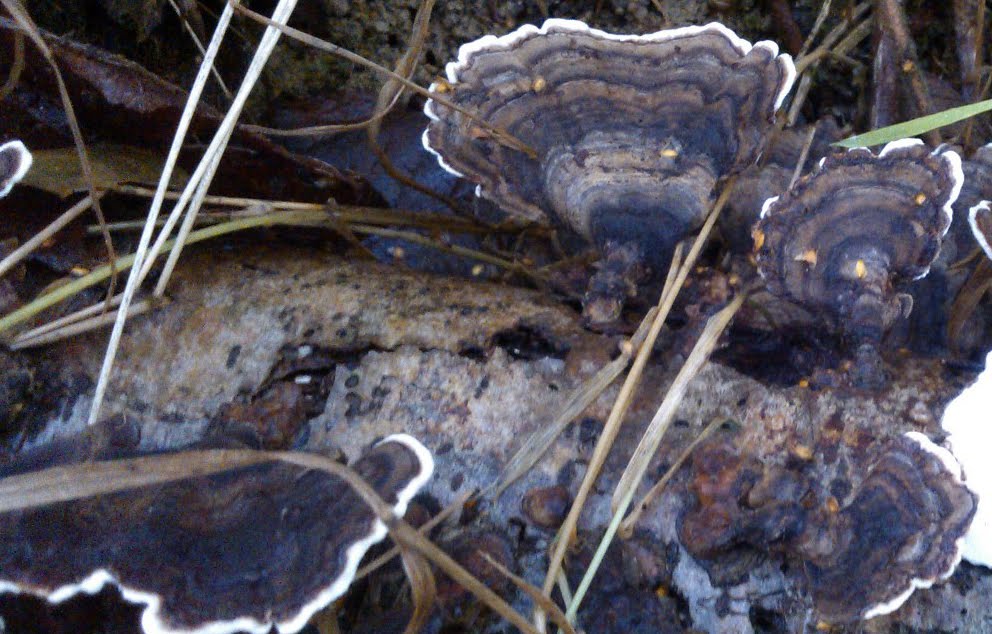
Outside of that, I saw two different types of fungus.  One is Turkey Tail (Trametes versicolor) that was growing on a felled silver birch.  The growth was quite young so it felt velvety.  There were several pores per millimetre on the underside, which was entirely white.  The fungus is listed as "inedible" on several sites.  Which is fair, because it feels leathery and unpalatable:


The underside is a proper white colour on these particular Turkey Tails.

I also saw a Common Earthball (Scleroderma citrinum).  Scleroderma citrinum literally means hard-skinned and lemon in colour, more or less, which isn't far off the mark as they feel almost rock hard to the touch:


This little mushroom is also called pigskin poison puffball and isn't a puffball at all -- it's an earthball.  Puffballs have a single opening in the top through which the spores disperse; earthballs prefer to break up and release their spores.  Common earthballs have black spores and it's worth noting that the spores may cause crying, conjunctivitis, runny nose and nosebleeds in some people -- and you'd definitely not want to be eating them.  Gastrointestinal distress is the term used.  Even that's too colourful!

And then... there was rain.  All of the rain.  So, I may head out that way tomorrow as long as it's not, you know, a proper deluge.  My ID books hate water.

Wednesday, 29 August 2012

Gathering Week

Ow.  This last week has been a hammer.

So, Monday -- first day volunteering at Record.  Actually, that was the day of rest and it was really good to get back into using GIS programs (even if it was MapInfo, which isn't my preference).  Still, I'd not done much with digitising NVCs before, so it was a really good experience and this weekend, I'll be doing some mycology off the back of it.  In short, I'll be learning some more about fungi and lichens.  Yes.  I'm weird.  I am aware of this.  Though the weirdest thing about volunteering at a biological records centre was the response to a team member finding a dead bat in one of the storage boxes.  Record collects all the biological sighting data for Cheshire... so of course there was interest in recording the type of bat and it's gender before getting rid of the poor thing (and it's new inhabitants.  Grim).  The bat situation was eventually resolved (and recorded, sadly).  I followed this up with a games evening in the pub, which was quite cathartic and made some new friends, which was good.  I also had a mooch earlier in the day where I spent some time hanging out with the red pandas.  I have to admit to watching one of them with great joy as they munched on one of the hawthornes in their enclosure with every sign of enjoyment.

And then I had a week where I could find no new jobs to apply for.  But that also gave me a week to do leatherworking.  Specifically faction symbols, more guild symbols, a belt with tonnes of pouches, bards sashes, a bandolier... it raised a lot of money for the faction, which is fantastic, plus it covered the make costs, so I'm a happy bunny (see all the tags below!)


Getting those metal stamps made saved my sanity.

Outside of that, the event this last weekend just about broke me. Still, I think I had fun -- I just wish I didn't attempt to get all my exercise for the month in in one weekend.  Yeowch.

As a side note, I now have over 300,000 followers on Pinterest.  I'm still shocked about it, but still -- very cool. It's made me think about adding to this blog and creating some infographics about ecology.